

Vertical Layout- (Elegant Design)
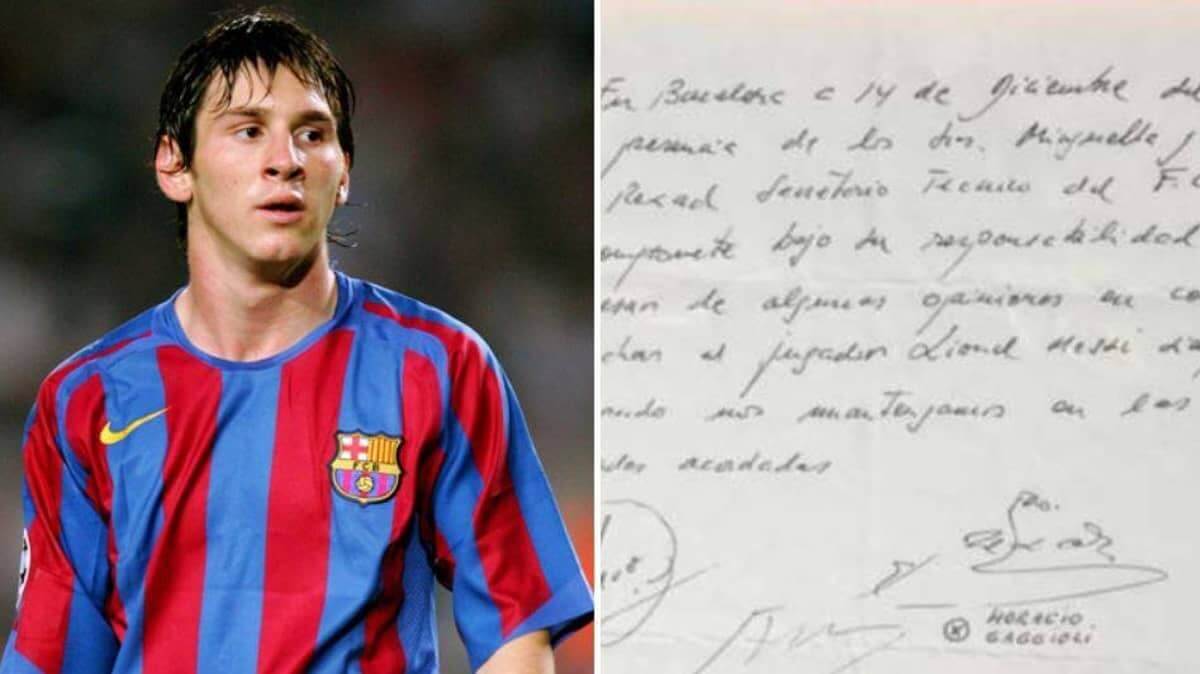
On 14 December, few months after Messi’s trial, an ultimatum was issued for Barcelona to prove their commitment. First team director Carles Rexach didn’t have any paper nearby, but his urgency to sign Messi made him write the contract on a paper napkin.

After being called up to the senior team, Messi made his first appearance in an official match on October 16, 2004, against Espanyol in La Liga, coming on in the 82′ minute.

Messi scored his first goal on May 1, 2005, against Albacete, assisted by Ronaldinho, becoming the youngest ever goalscorer for the club at that time.

Messi led Argentina to trophy in the 2005 FIFA Youth Championship. Before the final, Messi was awarded the Golden Ball as the tournament’s best player.
He scored twice in the final against Nigeria (2-1) winning the championship for Argentina and finishing the tournament as the top scorer with 6 goals.

[cool-timeline layout="default" designs="design-4" skin="default" category="team" show-posts="4" order="ASC" icons="dot" animations="fade-up" story-content="full" based="custom"]
Compact Layout- (Flat Design)
On 14 December, few months after Messi’s trial, an ultimatum was issued for Barcelona to prove their commitment. First team director Carles Rexach didn’t have any paper nearby, but his urgency to sign Messi made him write the contract on a paper napkin.
After being called up to the senior team, Messi made his first appearance in an official match on October 16, 2004, against Espanyol in La Liga, coming on in the 82′ minute.
Messi scored his first goal on May 1, 2005, against Albacete, assisted by Ronaldinho, becoming the youngest ever goalscorer for the club at that time.
Messi led Argentina to trophy in the 2005 FIFA Youth Championship. Before the final, Messi was awarded the Golden Ball as the tournament’s best player.
He scored twice in the final against Nigeria (2-1) winning the championship for Argentina and finishing the tournament as the top scorer with 6 goals.

[cool-timeline layout="compact" designs="design-2" skin="default" category="team" show-posts="4" order="ASC" icons="dot" animations="fade-up" story-content="full" based="custom" compact-ele-pos="main-date"]
Horizontal Layout- (Classic Design)
A Resolution to Explore Apple’s History
The Apple I, hailed as the pioneering creation of the tech industry, marked the genesis of the legendary Apple Inc. Designed and handcrafted in 1976 by the brilliant mind of Apple’s co-founder, Steve Wozniak, this revolutionary computer sparked a chain of events that would forever change the face of modern computing. Conceived through the visionary collaboration with his friend and co-founder, Steve Jobs, the Apple I paved the way for the global tech empire we know today. With its humble yet powerful beginnings, this iconic device laid the foundation for a world captivated by innovation and imagination, forever etching its name in the annals of computer history.
Pioneering Innovation, Costly Ambition
The Apple Lisa computer, an ambitious marvel of its time, revolutionized the computing landscape with a fusion of cutting-edge features. Boasting an integrated screen, a user-friendly interface, and Apple’s first-ever mouse, the Lisa marked a pivotal milestone in the history of personal computing.
The Portable Computer of 1984
In the pioneering era of personal computing, the Apple IIc emerged as a trailblazer in the realm of portability. Dating back to 1984, this compact marvel was deemed a ‘portable’ computer, offering users the convenience of mobility like never before.
The Birth of Affordability and Graphical User Interface in 1984
In the groundbreaking year of 1984, the tech world witnessed not one but two remarkable milestones. Alongside the advent of portable Apple computers, the revolutionary Macintosh computer was born. Marking a pivotal moment in computing history, the Macintosh emerged as the first ‘affordable’ computer featuring a revolutionary graphical user interface (GUI).
The Iconic Journey of Innovation
In the annals of technology history, the departure of Steve Wozniak marked a turning point for Apple Inc. as it embarked on a new chapter under the leadership of chief executive John Sculley. However, behind the scenes, a dramatic power struggle ensued, with Sculley attempting to oust Steve Jobs from his positions as chairman of the board and head of the Macintosh division.
[cool-timeline layout="horizontal" category="team" skin="default" designs="design-3" show-posts="5" order="ASC" items="2" icons="dot" story-content="full" based="custom" autoplay="false" start-on="0"]


